
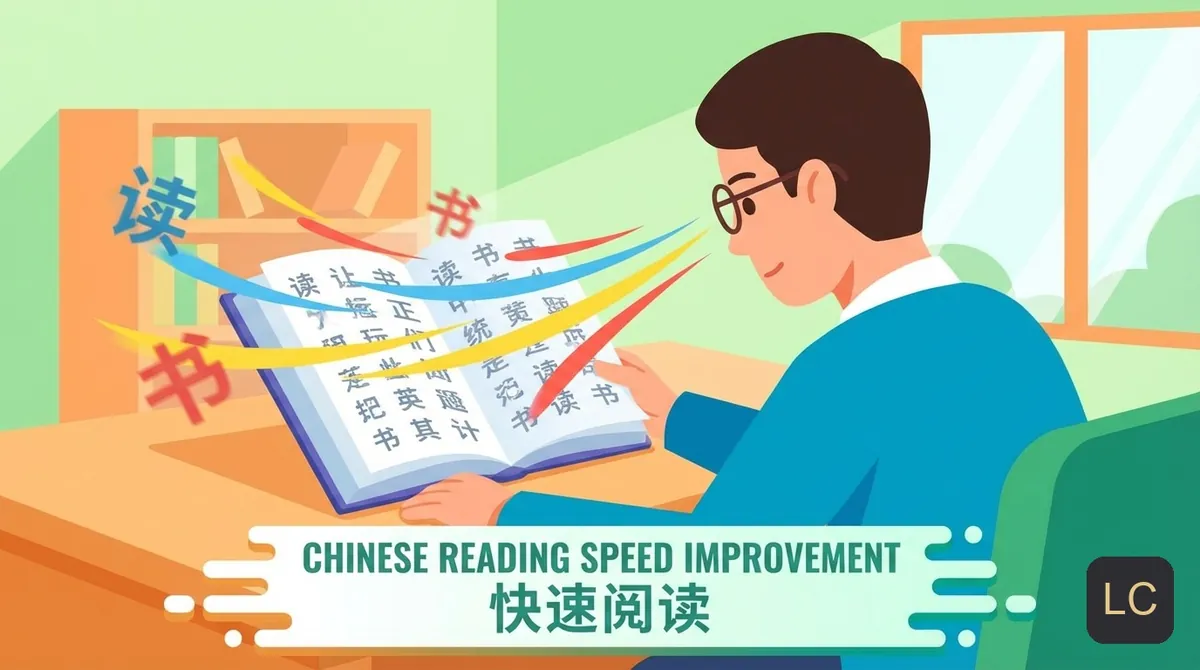
You've done the hard work. You've memorized thousands of characters, passed your HSK levels, and can handle most conversations. But there's still something that feels slow about reading Chinese. Really reading, not carefully decoding every character.
You watch native speakers zip through articles and wonder: how do they do that? The answer isn't some hidden talent or secret method. It's a set of skills you can train, just like you trained your vocabulary.
The good news: if you've already reached an intermediate level, you have the foundation. What you need now is specific practice to retrain your brain to process Chinese the way natives do.
We see this pattern constantly with learners who've studied Chinese for 2-3 years. They can pass written exams but find reading a novel or news article exhausting. Not because they don't know the words—they do. But their reading is still working too hard.
The bottleneck isn't vocabulary. It's how the brain processes visual information in Chinese. Once you understand what's happening, you can fix it. The learners who make the jump aren't any smarter than those who stay stuck. They just trained a different set of muscles.
Why Your Reading Feels Slow
There are three main reasons advanced learners struggle with reading speed, and understanding them is the first step to fixing it.
The first is character-by-character decoding. Early in your Chinese studies, you learned to identify each character individually. This was necessary. But now your brain is still treating every character as a separate unit to decode, like a machine reading one letter at a time.
The second is subvocalization. This is the inner voice reading along with you. It's natural in early stages, but it limits you to the speed of speech. Native readers have mostly suppressed this. They're "seeing" meaning directly, not converting characters to sounds first.
The third is unfamiliarity with common character combinations. Words in Chinese aren't always single characters. Two-character and three-character words make up the majority of text. If you haven't internalized these chunks, you're constantly assembling them on the fly.
Technique 1: Chunking
The fastest way to improve reading speed is to stop seeing individual characters and start seeing groups. A native reader doesn't see 中-国-人-在-公-园-里-散-步. They see 中国人, 在, 公园里, 散步. Four chunks instead of nine processing steps.
How do you train this? Start by deliberately scanning text and trying to identify common word patterns. When you read, notice the two-character and three-character combinations that repeat. Your brain will start to automatize this with practice.
Research on skilled Chinese readers shows they process 4-5 characters at a time, not one at a time. This is called the "visual span." Expanding yours takes conscious effort at first, then becomes automatic.
Technique 2: Reduce Subvocalization
You can't completely eliminate the inner voice—that's not realistic. But you can train it to become quieter and faster. One method is increasing reading speed deliberately. When you push yourself to read faster, the inner voice can't keep up and starts to fade.
Try this: find a Chinese text at your level and set a timer for one minute. Read as much as you can. Note where you stopped. Next time, try to beat that number. The goal isn't comprehension at first—it's speed. Your brain learns to skip the sound conversion step.
There's a reason this works: Chinese is logographic, not phonetic. The written characters don't represent sounds directly. Your brain doesn't need to convert them to pinyin to extract meaning. You're just used to doing it anyway.
Technique 3: Extensive Reading
This is the most important technique, and the one most learners skip. They study vocabulary, do grammar exercises, and practice reading only in controlled conditions. Real reading speed only develops through大量 reading—reading a lot.
The key is volume. Read Chinese every day, even if just for 20-30 minutes. Novels, articles, social media posts—it all counts. The more time your eyes spend on Chinese characters, the faster your brain learns to process them.
Don't worry about understanding every word. Read for gist and keep moving. If you're looking up every unknown word, you're not reading—you're studying. Both are valuable, but they train different skills.
Research on second language reading acquisition consistently shows that extensive reading is the primary driver of reading speed development. There's no substitute for time spent with authentic text.
Technique 4: Character Frequency Training
Here's a specific drill: spend time with high-frequency character combinations in isolation. The top 500-1000 two-character words make up the vast majority of any Chinese text. If you recognize these instantly, reading becomes much smoother.
You can use Chinese flashcards to build this recognition. But more importantly, expose yourself to these common combinations repeatedly. The goal is instant recognition—the same way you recognize "the" or "and" in English without thinking.
When you encounter a new character combination, make a mental note. If it's common, you'll see it again soon. Each exposure builds the pattern in your brain. Over time, your visual vocabulary expands without explicit memorization.
Key Takeaway
Reading speed at advanced levels isn't about learning more—it's about processing differently. Train chunking, reduce subvocalization, and read extensively. The goal is 100+ characters per minute, which is achievable with consistent practice. Start with 20 minutes of daily extensive reading and add speed drills twice a week.
Heritage Speakers: A Different Challenge
If you grew up speaking Chinese but didn't learn to read formally, your challenge is different. You have the spoken vocabulary but haven't wired character recognition to it yet.
The techniques above still apply, but you have a unique advantage: you already know how the words sound. When you see 图书馆 (túshūguǎn), you already know it means "library." You just need to connect the characters to that knowledge.
For heritage speakers, reading extensively with tap-to-reveal features works especially well. You see the characters, tap to confirm your guess, and build the visual connection to words you already know orally. Progress can be surprisingly fast once you push past the initial discomfort.
The Bottom Line
Reading speed isn't a talent. It's a skill, and skills can be trained. The learners who read fast didn't get there by being smarter or having better memories. They read more, pushed their speed deliberately, and trained their brains to process Chinese efficiently.
Start with 20 minutes of daily extensive reading. Add one speed drill session per week. Track your characters-per-minute and watch it climb. Within a few months, you'll notice the difference.
The goal isn't just faster reading—it's more enjoyable reading. When reading feels easy, you read more. And reading more is the single best thing you can do for your Chinese.
Build Your Reading Speed Today
Literate Chinese provides free leveled reading practice and spaced repetition flashcards designed specifically for intermediate and advanced learners. Start with content matched to your level and watch your speed improve.
Try Free Reading PracticeRelated reading: Building a Sustainable Chinese Reading Habit · The Comprehensible Input Approach to Chinese