
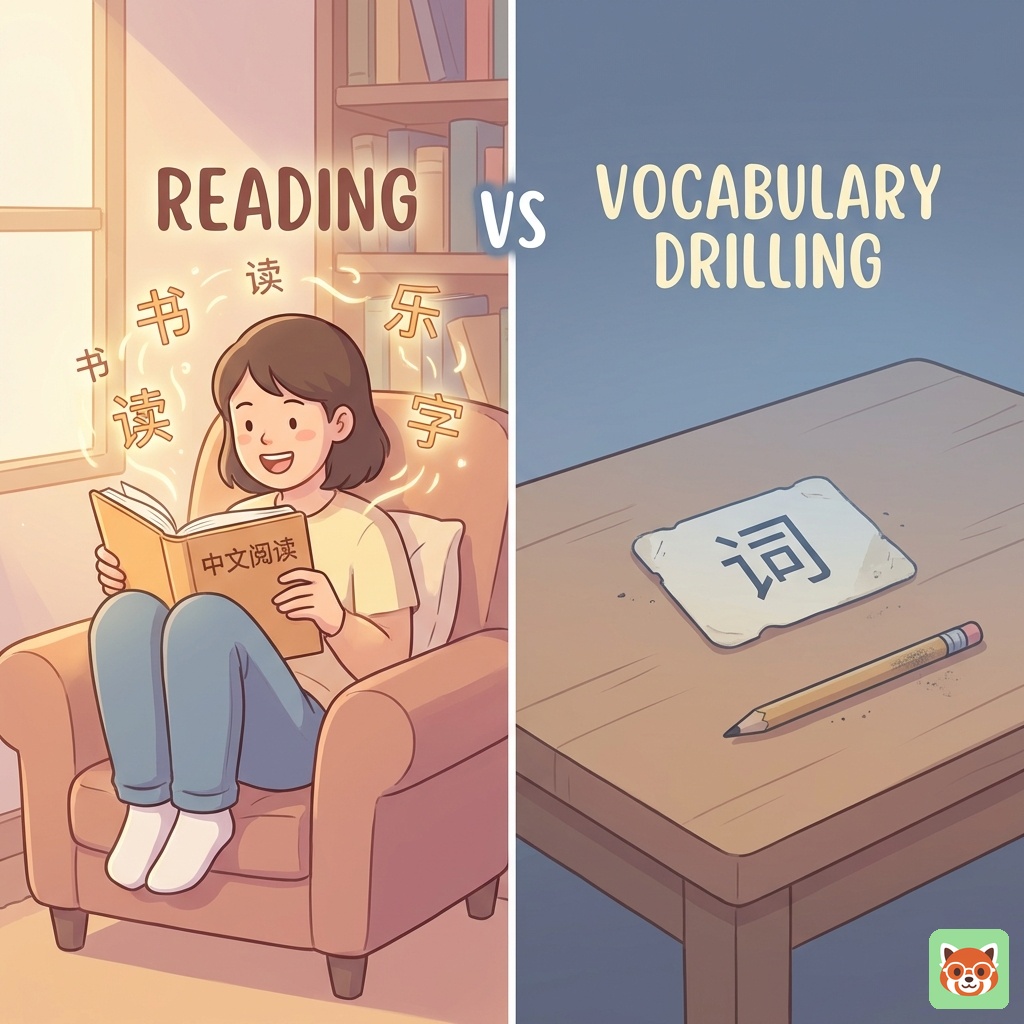
You've probably seen the promise: "Learn 1000 words in 30 days!" Chinese learning apps love to push vocabulary drilling. Flashcard decks. Spaced repetition. Daily reviews. It feels productive. You're checking boxes. You're "doing the work."
But here's the uncomfortable truth: most of that drilling doesn't translate into real fluency. You can recognize a word on a flashcard and still freeze when you see it in context. You can pass a vocabulary quiz and still can't read a simple article.
The reason is simple. Vocabulary drilling trains recognition, not comprehension. It builds a shallow layer of memorization that doesn't hold up when you actually try to use the language.
Note from the Founder
"I spent years drilling flashcards. I knew thousands of words. Then I tried to read a Chinese novel and couldn't get through a page. That's when I realized I'd been fooling myself. The vocabulary I 'knew' from flashcards wasn't connected to anything real. I started reading instead, and everything changed. Within six months, I was reading novels I'd never thought possible. That's why I built Literate Chinese around reading practice instead of just flashcards."
The Science Behind Why Drilling Falls Short
Researchers have known for decades that vocabulary acquisition happens best through meaningful context, not isolated memorization. Here's what happens when you only drill flashcards:
You're learning definitions, not connections. A flashcard shows you a word and its meaning. But it doesn't show you how that word connects to other words, how it's used in sentences, or what contexts it appears in. You're memorizing a dictionary entry, not acquiring language.
The context is artificial. Flashcards remove the context that helps real language learning. In real life, you understand words from surrounding context, tone of voice, visual cues, and real-world situations. An isolated word on a card trains a different skill than understanding language in context.
It doesn't build automaticity. Real fluency means processing words instantly without conscious thought. Drilling creates conscious回忆 (huíyì - recall) rather than unconscious recognition. You'll always pause to "translate" in your head instead of understanding directly.
It's boring and hard to maintain. Let's be honest. Drilling hundreds of flashcards daily is not enjoyable. And if it's not enjoyable, you won't stick with it. Consistency beats intensity every time in language learning.
What Actually Works: Extensive Reading
Extensive reading means reading large amounts of material at an appropriate level. It's what native speakers do to build vocabulary naturally. And it's remarkably effective for Chinese learners, for several reasons:
You learn words in context
When you encounter a word while reading a story, you see it used naturally. You understand not just what it means, but how it's used, what words it typically goes with, and what situations it appears in. That's deeper learning.
Repetition happens naturally
Good reading material introduces words gradually and repeats them across multiple pages. You'll see common words dozens of times without trying. That's spaced repetition, but embedded in actual content rather than flashcards.
You learn connected vocabulary
Words don't exist in isolation. When you read about a specific topic, you encounter related vocabulary together. You learn that 吃 (chī) goes with 饭 (fàn), that 天气 (tiānqì) often pairs with 晴 (qíng) or 阴 (yīn). These collocations are hard to learn from flashcards but easy to pick up from reading.
It builds comprehension, not just recognition
When you're reading for understanding, you're actively processing meaning. You're guessing from context, connecting ideas, following a narrative. That creates real comprehension skills that transfer to real-world listening and speaking.
How Extensive Reading Compares to Drilling
| Factor | Vocabulary Drilling | Extensive Reading |
|---|---|---|
| Context | Isolated words | Natural sentences and stories |
| Retention | Short-term memorization | Long-term acquisition |
| Transfer | Poor to real usage | Strong to comprehension |
| Enjoyment | Often tedious | Engaging (you're reading for fun) |
| Time efficiency | High "study time," low results | Lower "study feeling," better results |
How to Apply Extensive Reading to Chinese
The key is finding material at the right level. If every other word is unfamiliar, you'll get frustrated. If you know everything already, you won't learn anything new.
The magic threshold is knowing 90-95% of characters. That means for every 20 characters you know, you'll encounter one new one. That's manageable. You'll still understand the overall meaning while gradually picking up new vocabulary.
Starting at this level might feel slow. But it's the most efficient path. You'll be reading real content from day one, building real skills, and acquiring vocabulary naturally. A few months in, you'll look back and realize you've read your way to fluency.
How to find your level
Pick a text and count how many unknown words you encounter in a paragraph. If it's more than one or two per sentence, it's too hard. Drop down to easier material. There's no shame in starting with elementary-level stories. Everyone does.
As you progress, you'll naturally move to harder material. Your vocabulary expands, and what once seemed difficult becomes comfortable. This is the virtuous cycle of extensive reading.
Key Takeaway
Replace some of your flashcard time with reading time. Even 20 minutes of daily reading will yield better results than an hour of drilling. The goal isn't to "cover" vocabulary—it's to build the ability to understand Chinese in the wild.
Making Reading Work for You
If you're ready to try extensive reading, here's how to start:
1. Find level-appropriate content. Use leveled reading practice that matches your current vocabulary. Literate Chinese tracks which words you know and adjusts text difficulty accordingly.
2. Read for enjoyment, not perfection. Don't look up every unknown word. Try to understand from context first. Only look up words that block comprehension. This keeps reading flow intact while still building vocabulary.
3. Read consistently. Twenty minutes daily beats two hours once a week. Build a reading habit. Keep your book or app accessible so you can read during downtime.
4. Use flashcards as a supplement, not the main event. Flashcards work well for high-frequency characters and for reviewing vocabulary you've encountered in reading. But they shouldn't be your primary learning method.
5. Track your progress. Measure by pages read and books finished, not cards reviewed. There's something satisfying about finishing a novel in Chinese that flashcards can never match.
The Bottom Line
Vocabulary drilling feels productive because it's measurable. You can quantify how many cards you've reviewed. But measuring activity isn't the same as measuring progress.
Extensive reading is harder to quantify but far more effective. You'll acquire vocabulary naturally, build real comprehension skills, and actually enjoy the process. You'll also develop the reading ability you need for real-world Chinese—from signs to messages to novels.
The apps that push drilling are selling you a myth: that you can shortcut fluency through memorization. You can't. Language acquisition happens through meaningful input, in context, over time. That's what extensive reading provides.
Start Reading in Chinese Today
Literate Chinese combines leveled reading with smart flashcards to help you acquire vocabulary through context. Best of all, it's free to use. No subscriptions, no locked features.
Start Learning for FreeYour future self will thank you for choosing the harder but more effective path. Put down the flashcards. Pick up a book. Start reading.
Want to compare approaches? See how Literate Chinese vs Hack Chinese stack up, or learn about heritage speakers and reading practice.