
Literate Chinese vs Du Chinese: an honest comparison
Both are graded-reading apps for Mandarin learners, and both are good. Du Chinese has the bigger, more polished library with human narration. Literate Chinese matches stories to the words in your own flashcard deck and fully supports Taiwan Mandarin. Here is how they actually differ.
The short answer
Choose Du Chinese if…
- You want professional native-speaker narration, synced with the text, for listening while you read.
- You want the larger library: 3,000+ stories, articles and courses, with long multi-chapter serials at the upper levels.
- You like clear fixed levels (Newbie to Master) and want to read on a computer too. Du Chinese runs on iOS, Android, Mac and the web.
- Your school will buy a group license. Du offers school subscriptions and classroom trials.
Choose Literate Chinese if…
- You want stories chosen by the exact characters you know, with a familiarity percentage on every story and flashcards that share the same vocabulary.
- You're learning Taiwan Mandarin: Taiwan-accent audio, book-style zhuyin beside each character, and vocabulary that switches between Mainland and Taiwan usage.
- You want a bigger free tier (230+ stories free in the app) or a lower annual price ($99.99 vs $119.99).
- You teach. A free class code unlocks the full app for a whole class until the end of the school year.
Or both: You don't have to choose. The libraries don't overlap, and Du's human audio pairs well with Literate's vocabulary tracking and Taiwan support.
Du Chinese vs Literate Chinese at a glance
Checked against each company's own website and app-store listings in October 2026. Prices are US list prices; app-store prices vary by country.
| Feature | Du Chinese | Literate Chinese |
|---|---|---|
| What it is | Reading and listening app: graded stories, articles and courses | Graded-reader app with built-in spaced-repetition (SRS) flashcards |
| Library | 3,000+ stories, articles and courses, including 80+ graded stories (many of them multi-chapter). New lessons every weekday, per their Play listing | 1,000+ graded stories, from 50-character beginner tales to adapted classics |
| Levels | Six fixed levels (Newbie, Elementary, Intermediate, Upper Intermediate, Advanced, Master) with HSK markings | No fixed bands. Each story shows the % of its characters you already know |
| Characters | Simplified and Traditional | Simplified and Traditional |
| Pinyin / zhuyin | Pinyin, tones only, or bopomofo (zhuyin). Pinyin can be limited to difficult words | Pinyin or zhuyin, with zhuyin set vertically beside each character like a Taiwanese book. Option to hide pinyin on characters you know |
| Audio | Recorded by native speakers for every lesson, synced with the text. Speed control; audiobook mode with Premium | Synthesized Mainland and Taiwan voices for every word, sentence and story, with separate male and female voices in dialogue |
| Mainland / Taiwan | Mainland-focused content (everyday life in China, Chinese history). No Taiwan-accent audio or Taiwan vocabulary advertised | Both. Switch accent and region; stories swap regional words (地铁 → 捷運) |
| Flashcards | Built-in SRS for words you save, with sync to Pleco, Skritter, Hanping and Hack Chinese | SRS on your personal vocab bank, with HSK 2.0/3.0, TOCFL, AP and themed lists. Words you read count toward it. Lists export as CSV |
| Other tools | Grammar explanations, stroke-order animations, tone colors, recommendations from your reading history | Writing practice, comprehension quizzes on most stories, word capture from photos or audio, an AI word helper |
| Platforms | iPhone, iPad, Mac (Apple silicon), Android, web | iPhone, iPad, Android. 280 stories also free on this website |
| Offline | Yes, with Premium | Not offered as a feature |
| Free tier | A selection of free lessons; free sample chapters on the web | 230+ stories free in the app, plus core flashcards and word lists; 280 stories free in your browser with no account |
| Price (US) | $14.99/month · $79.99/6 months · $119.99/year | $12.99/month (7-day free trial) · $99.99/year (14-day free trial) · $199 lifetime |
| For schools | Discounted group subscriptions (over 90% off individual pricing) and a free classroom trial | Free class codes covering a whole class through the school year. No teacher dashboard yet |
Where Du Chinese is stronger
Audio. Every Du Chinese lesson is narrated by native speakers and the audio is synced with the text, so you can read along, slow it down or switch to audiobook mode with Premium. Literate Chinese uses high-quality synthesized voices. They're clear and cover every word and sentence, but they don't sound like a human storyteller. If listening while reading is the core of how you study, Du's recordings are worth paying for.
Library size and polish. Du Chinese lists 3,000+ readings across stories, articles and courses. At the upper levels its serials run to 20 chapters or more, adapting Chinese legends and writing original mysteries. Literate's 1,000+ stories are mostly shorter reads, with some multi-part series. If you're past HSK 5 and want long-form material, Du has more of it.
Platforms and offline use. Du runs on iPhone, iPad, Mac, Android and the web, and Premium includes offline study. Literate Chinese is a phone and tablet app, and offline reading isn't a feature it offers.
Schools that buy licenses. Du sells discounted group subscriptions and offers a free classroom trial, and it has a content guide for teachers.
Where Literate Chinese is different
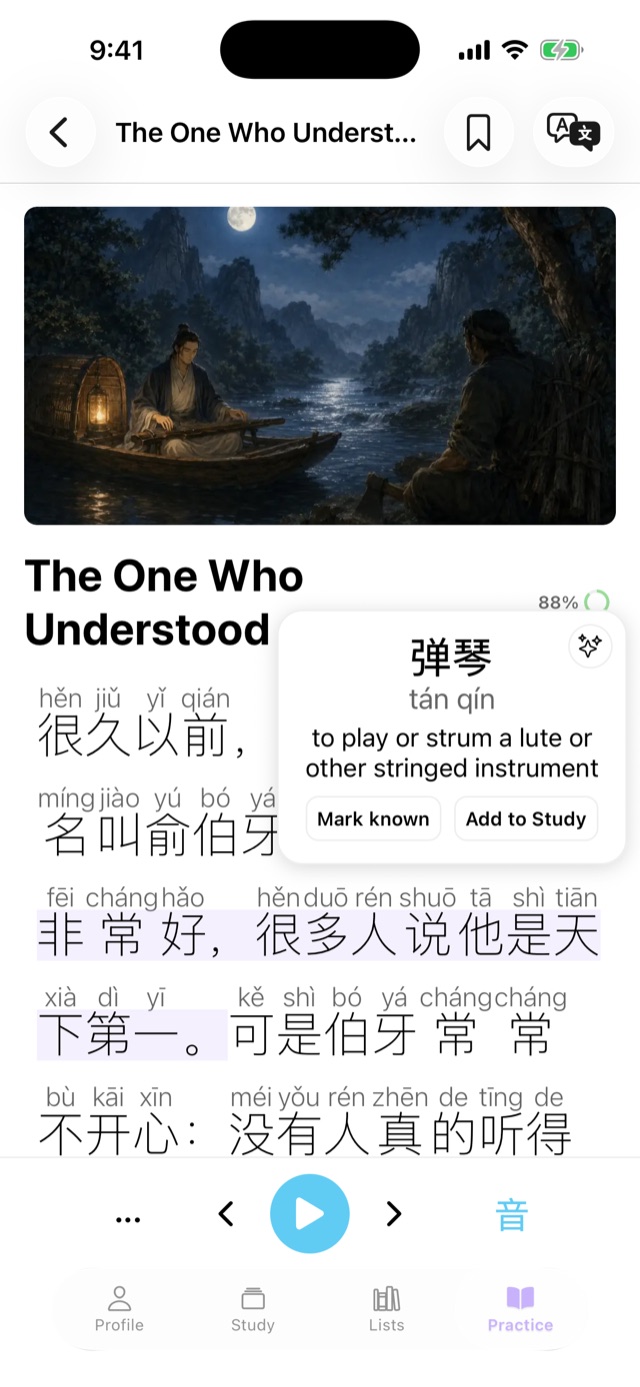
Stories matched to your own vocabulary. Du sorts lessons into six levels and recommends lessons from your reading history. Literate has no fixed bands. It tracks the words you've studied and read, and shows every story's familiarity percentage based on the characters you actually know. Reading and flashcards share one vocabulary bank: look up a word in a story and it can go into your review deck, and finishing a story counts the words you met.
Taiwan Mandarin. Both apps show Traditional characters, and Du can show bopomofo instead of pinyin. What Literate adds is the rest of the Taiwan picture: Taiwan-accent audio, zhuyin drawn vertically to the right of each character as it is in Taiwanese children's books, region-aware vocabulary (set it to Taiwan and 地铁 becomes 捷運), and TOCFL word lists.
Pinyin that fades as you learn. Du can show pinyin only for difficult words, judged by level. Literate's setting hides pinyin on the characters you know, using your own vocabulary bank.
Price and free tier. In the US, Literate Premium is $99.99 a year against Du's $119.99. More than 230 stories are free in the app, and 280 can be read on this website with no account.
How the two fit together
These apps compete less than it looks. One sensible setup is to use Du Chinese for narrated listening and longer serials, and Literate Chinese for vocabulary-matched reading and SRS review. Taiwan-track learners can lean on Literate for zhuyin and Taiwan audio. Du's flashcards also sync with Pleco, Skritter and Hack Chinese if you already study in one of those.
Whichever you choose, use the free tiers first. Reading volume is what builds fluency, so the right app is the one whose stories you'll actually finish.
Who each app is for
Du Chinese suits
- Learners who study by listening as much as reading
- Intermediate and advanced readers who want long serial stories
- People who read on a laptop or need offline access
- Schools with budget for group licenses
Literate Chinese suits
- Learners who want reading and flashcards in one loop
- Taiwan Mandarin, TOCFL and zhuyin learners
- Heritage speakers who understand Chinese but read little
- Budget-conscious learners and teachers who want free classroom access
Frequently asked questions
Is Du Chinese or Literate Chinese better for beginners?
Both start at absolute beginner. Du Chinese has beginner courses and a Newbie level with human audio. Literate Chinese has free beginner series written with a few dozen characters, and its familiarity percentage shows which stories you can already read. If you're unsure where you stand, take the free character test first.
Does Du Chinese support zhuyin and Traditional characters?
Yes. Du Chinese offers Simplified or Traditional characters, and its reader can show pinyin, tones only, or bopomofo (zhuyin). Du doesn't advertise Taiwan-accent audio or Taiwan vocabulary. Literate Chinese adds Taiwan-accent audio, book-style vertical zhuyin and region-aware vocabulary.
How much does Du Chinese cost compared with Literate Chinese?
In the US, Du Chinese costs $14.99 a month, $79.99 for six months or $119.99 a year. Literate Chinese costs $12.99 a month or $99.99 a year (with 7- and 14-day free trials), or $199 for lifetime access. Both have free tiers, and prices vary by country. Both companies' prices were checked in October 2026.
Which app has better audio?
Du Chinese. Its lessons are recorded by native speakers and synced with the text. Literate Chinese uses synthesized Mainland and Taiwan voices, which cover every word and sentence and let you hear the Taiwan accent, but they aren't human narration.
Can I use Du Chinese and Literate Chinese together?
Yes. The libraries don't overlap, so reading in both doubles your material at each level. One sensible split is Du for narrated listening and long serials, and Literate for vocabulary-matched stories, flashcards and Taiwan Mandarin.
Is there a free alternative to Du Chinese?
Literate Chinese has 230+ free stories in the app, and you can read 280 graded stories free in your browser on this site, sorted by level, with no account. Du Chinese also has free lessons.
Try reading before you decide
You can test Literate Chinese's stories without installing anything. These are free on this site:
Try reading your first story
The fastest way to make characters stick is to meet them in a story you can actually finish. Literate Chinese has 1,000+ graded stories matched to the words you know — in Mainland or Taiwan Mandarin, Simplified or Traditional. Free on iOS and Android.


Prefer the browser? Read a free story on the web →
Sources and method
Du Chinese facts come only from the pages below, checked on . Where we couldn't confirm something (for example, a feature that isn't mentioned anywhere public), the table says so rather than guessing. Literate Chinese facts come from the app itself and its App Store and Google Play listings.