
Kaburazushi かぶらずし

N4 (est.) Chapter 30 of 60 of the Reading Trail, “Emma in Kanazawa” · 465 characters · 59 different kanji

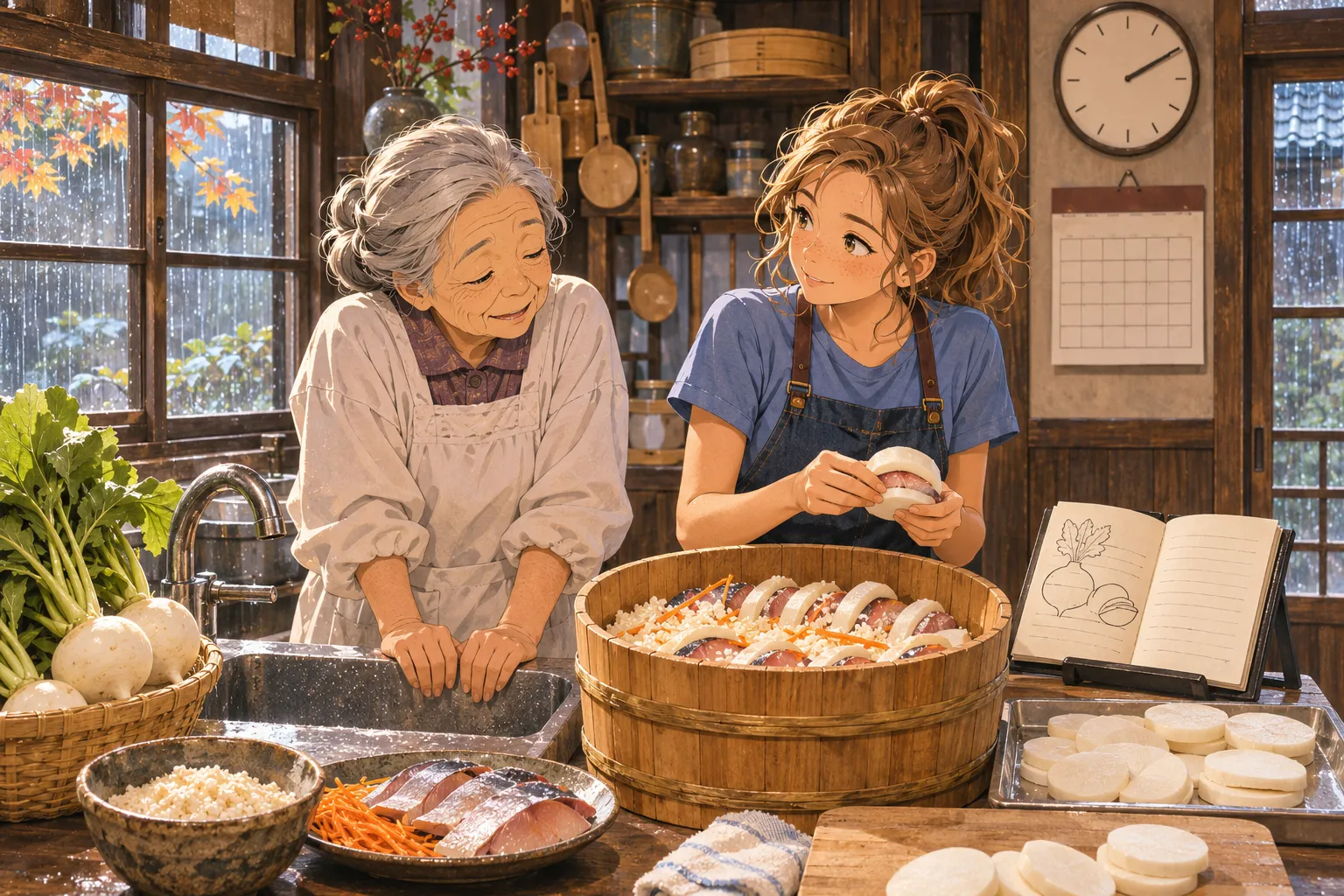
Illustration for the Japanese story Kaburazushi

Grandma and Emma make the winter pickle from Grandpa's notebook. After an hour of silence, Grandma talks.

Tap any word for its meaning and sound.

エマは、学がっ校こうの教きょう室しつでも家いえでも、まだ元げん気きがなかった。外そとは、細こまかい雨あめだった。ひるごはんのあと、おばあちゃんが黒くろいノートを出だした。「エマ、かぶらずしを作つくるよ。」ノートには、おじいさんの細こまかい字じがならんでいた。

Emma still had no energy, at school or at home. Outside, a fine rain was falling. After lunch, Grandma took out the black notebook. "Emma, we're making kaburazushi." Grandpa's small, careful handwriting filled the page.

おばあちゃんが、一ひとつずつ教おしえた。まず、かぶを半はん分ぶんに切きって、しおに入いれておく。ぶりは、もう、しおに入いれておいた。かぶは、白しろくて丸まるい。エマが切きったかぶは、少すこしあつかった。おばあちゃんは、直なおさなかった。

Grandma taught her one step at a time. First, you cut the turnips in half and leave them in salt. The yellowtail had already been salted. The turnips were white and round. Emma's slices were a little thick. Grandma didn't correct them.

一いち時じ間かん、二人ふたりはほとんど話はなさなかった。時計とけいの音おとだけが、聞きこえた。それから、おばあちゃんが小ちいさい声こえで話はなした。「わたしもね、22さいで、能登のとの小ちいさい村むらから金かな沢ざわに来きたがや。」「長ながい道みちやった。ここには、親おやもともだちも、いなかった。」「電でん話わもなかった。夜よる、この水みずの中なかに、なみだがおちた。」「村むらに帰かえりたかった。親おやに会あいたかった。」エマは、しずかに聞きいた。「同おなじやがいね。」「……はい。」「でもね、人ひとは少すこしずつ強つよくなるがよ。」

For an hour, the two of them hardly spoke. All they could hear was the clock. Then Grandma spoke in a quiet voice. "I came to Kanazawa from a little village in Noto when I was twenty-two, too, you know." "It was a long way. Here I had no parents and no friends." "There wasn't even a phone. At night, my tears fell into the water here." "I wanted to go back to my village. I wanted to see my parents." Emma listened quietly. "It's the same for you, isn't it." "…Yes." "But people get stronger, little by little."

二人ふたりは、かぶにぶりをはさんで、米こめこうじといっしょに、おけに入いれた。米こめこうじは、あまいにおいがした。おばあちゃんは、上うえから手てで強つよくおした。「12日じゅうににちまてば、食たべられる。」エマは、カレンダーの12日じゅうににちあとに、丸まるを書かいた。それは、やくそくのようだった。エマは、その丸まるを何なん回かいも見みた。その夜よる、エマは少すこし元げん気きが出でた。

The two of them tucked the yellowtail into the turnips and packed them into a tub with rice koji. The rice koji smelled sweet. Grandma pressed down hard from the top with her hands. "If we wait twelve days, we can eat it." Emma drew a circle on the calendar twelve days ahead. It was like a promise. Emma looked at that circle again and again. That night, Emma felt a little better.

Check your understanding

3 questions about “Kaburazushi”. Tap an answer to check it.

1. おばあちゃんとエマは、なにを作つくったか。

2. おばあちゃんは、なんさいで金かな沢ざわに来きたか。

3. かぶらずしは、いつ食たべられるか。

Words in this story

The first 40 of 104 different words in “Kaburazushi”, in the order you meet them, in dictionary form, with reading and English. Particles are left out.

WordReadingMeaning
エマエマEmma (name); Emma Carter, American exchange student
学がっ校こうがっこうschool
教きょう室しつきょうしつclassroom; lecture room; department (in a university); class; lessons
家いえいえhouse; residence; dwelling; home; family
まだまだstill; as yet; only; (not) yet; more
元げん気きげんきlively; full of spirit; energetic; vigorous; vital
ないないnonexistent; not being (there); unowned; not had; unpossessed
外そとそとoutside; exterior; the open (air); other place; somewhere else
細こまかいこまかいsmall; fine; minute; minor; trivial
雨あめあめrain; rainy day; rainy weather; the November suit (in hanafuda)
だっただったwas; were
昼ひるご飯はんひるごはんlunch; midday meal
後あとあとbehind; rear; after; later; remainder
おばあちゃんおばあちゃんgranny; grandma; gran; old lady; old woman
黒くろいくろいblack; dark; blackish; sun-tanned (skin); suspicious
ノートノートnotebook; copy-book; exercise book; note; noting down
出だすだすto take out; to get out; to put out; to reveal; to show
かぶらずしかぶらずしkaburazushi; Kanazawa winter pickle of turnip and salted yellowtail fermented with rice …
作つくるつくるto make; to produce; to manufacture; to build; to construct
おじいさんおじいさんgrandfather; male senior-citizen; old man
字じじcharacter (esp. kanji); letter; written text; handwriting; penmanship
並ならぶならぶto line up; to stand in a line; to rival; to match; to equal
一ひとつひとつone; for one thing; only
ずつずつapiece; each; at a time; piecemeal
教おしえるおしえるto teach; to instruct; to tell; to inform; to show
まずまずfirst (of all); firstly; to begin with; before anything else; probably
かぶかぶturnip (Brassica rapa)
半はん分ぶんはんぶんhalf
切きるきるto cut; to cut through; to perform (surgery); to sever (connections, ties) …
塩しおしおsalt; common salt; table salt; sodium chloride; hardship
入いれるいれるto put in; to let in; to take in; to bring in; to insert
ブリブリJapanese amberjack (species of yellowtail, Seriola quinqueradiata)
もうもうalready; yet; by now; now; (not) any more
白しろいしろいwhite; blank (e.g. paper); uncolored; unmarked; spotless
丸まるいまるいround; circular; spherical; curved; smooth
高たかぶるたかぶるto become aroused (of emotions, nerves, etc.); to become excited; to become stirred up …
少すこしすこしa little; a bit; a small amount; a few; some
熱あついあついhot (to the touch); passionate (feelings, etc.); ardent; hot (e.g. gaze) …
直なおすなおすto repair; to mend; to fix; to correct (a mistake, bad habit, etc.); to put right
一いち時じ間かんいちじかんone hour

Readings and meanings are adapted from JMdict and KANJIDIC2, property of the Electronic Dictionary Research and Development Group, used under its licence (CC BY-SA 4.0). Still learning the kana? See the hiragana chart and the katakana chart.

Keep reading

This is one of the free stories in Japanese reading practice. In the Literate Japanese app every word you tap is saved for review, a natural Japanese voice reads each sentence, and the next story is matched to the kanji you know. The app is coming soon to iOS and Android.

Read your way to 300 kanji

Literate Japanese has 280+ graded stories from kana-only to estimated N2, with furigana you can turn off, every word one tap away, and flashcards built from what you read. The 60-chapter Reading Trail to your first 300 kanji is free. Coming soon to iOS and Android.

Email me when it launches

Start today in the browser: read a free Japanese story →