
Business Chinese for your new job
Just started a job where you work with colleagues, clients or suppliers in China or Taiwan? You don’t need to be fluent to be useful. You need the words that show up in every email and meeting, a handful of polite phrases, and to know which words change between Mainland China and Taiwan. This page is that starter kit.


Free flashcards below · business word lists and workplace stories in the Literate Chinese app
Where to start: your first month
Week 1: the office basics
Learn the words you will see every day: company, client, project, meeting, contract. Start with Business Essentials and Email & Meetings.
Week 2: your field
Add the vocabulary of your role. In marketing that means brand, campaign, budget, target customer and social media: the Marketing deck.
Weeks 3 and 4: read it in context
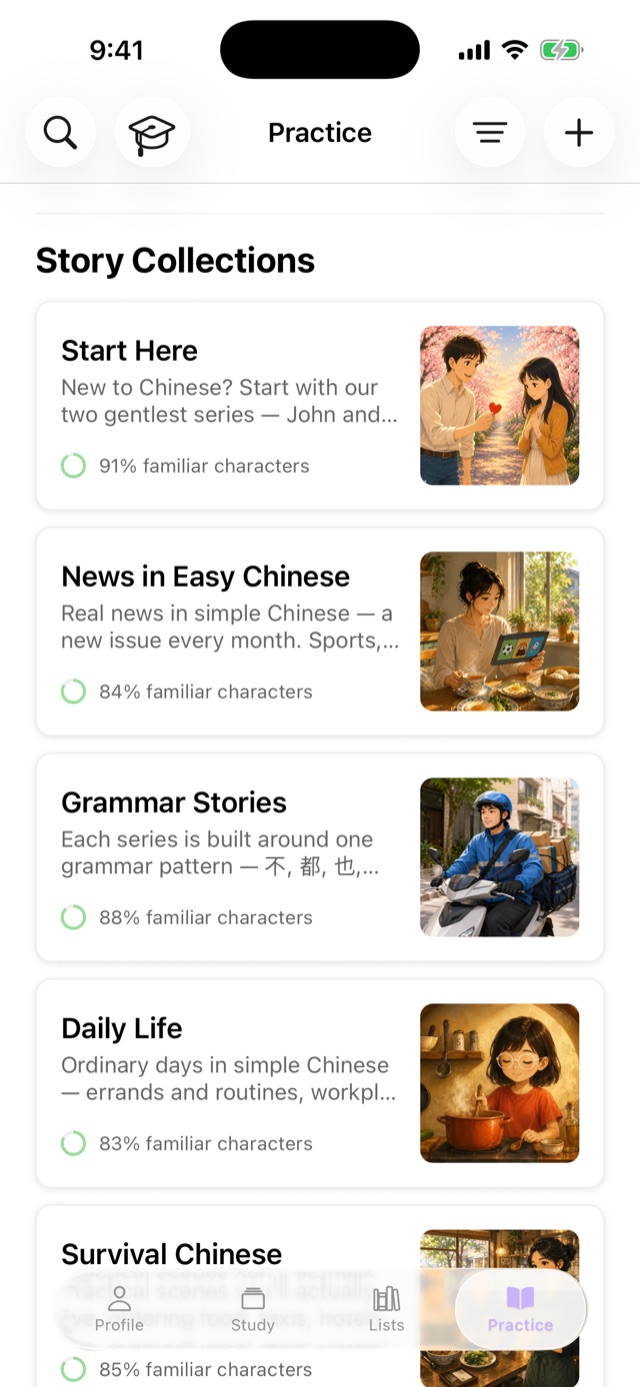
Words stick when you meet them in a story. Read short workplace stories (morning meetings, an email sent to the wrong client, a team launching an app) at a level matched to the characters you already know.
Business words are built from everyday characters (公司 is “public” + “manage”), so learn the first few hundred common characters alongside the business lists. The Literate Chinese app does both at once: it starts at the first 50 characters and matches every story to what you know.
Email phrases you will use every week
Chinese work email is more formal than English email, and set phrases do most of the work. In Mainland China a lot of daily work also happens on WeChat (微信) rather than email; in Taiwan, on LINE. The phrases below work in both.
| Chinese | English |
|---|---|
| 王总,您好!Wáng zǒng, nín hǎo!Taiwan: 王經理您好 | Hello, Mr./Ms. Wang (to a senior manager; 总 is short for 总经理, general manager) |
| 附件是报价单,请查收。Fùjiàn shì bàojiàdān, qǐng cháshōu. | Please find the quote attached. |
| 麻烦您确认一下。Máfan nín quèrèn yíxià. | Could you please confirm? (literally “sorry to trouble you”) |
| 收到,谢谢!Shōudào, xièxie! | Got it, thanks! |
| 我跟进一下。Wǒ gēnjìn yíxià. | I’ll follow up on it. |
| 如有任何问题,请随时联系我。Rú yǒu rènhé wèntí, qǐng suíshí liánxì wǒ.Taiwan: 如有任何問題,請隨時與我聯絡。 | If you have any questions, feel free to contact me. |
| 期待您的回复。Qīdài nín de huífù. | I look forward to your reply. |
| 祝好!Zhù hǎo!Taiwan, more formal: 敬祝 商祺 | Best regards (closing line) |
Meeting phrases
| Chinese | English |
|---|---|
| 我们今天主要讨论三件事。Wǒmen jīntiān zhǔyào tǎolùn sān jiàn shì. | Today we’ll mainly discuss three things. |
| 我补充一点。Wǒ bǔchōng yì diǎn. | Let me add one point. |
| 这个方案我们内部再讨论一下。Zhège fāng’àn wǒmen nèibù zài tǎolùn yíxià. | We’ll discuss this proposal internally. (a polite “not yet”) |
| 能不能把截止日期推迟到周五?Néng bu néng bǎ jiézhǐ rìqī tuīchí dào zhōuwǔ? | Could we push the deadline to Friday? |
| 下周之前给您答复。Xià zhōu zhīqián gěi nín dáfù. | We’ll get back to you before next week. |
Marketing phrases
| Chinese | English |
|---|---|
| 我们的目标客户是谁?Wǒmen de mùbiāo kèhù shì shéi? | Who is our target customer? |
| 这次活动的预算是多少?Zhè cì huódòng de yùsuàn shì duōshao? | What’s the budget for this campaign? |
| 我们想提高品牌知名度。Wǒmen xiǎng tígāo pǐnpái zhīmíngdù. | We want to raise brand awareness. |
| 先在社交媒体上推广。Xiān zài shèjiāo méitǐ shang tuīguǎng.Taiwan: 先在社群媒體上推廣。 | Let’s promote it on social media first. |
| 跟网红合作的效果怎么样?Gēn wǎnghóng hézuò de xiàoguǒ zěnmeyàng? | How well did the influencer collaboration work? |
Mainland China vs Taiwan: the business words that change
Most business vocabulary is shared, but a few everyday office words differ, and using the other side’s word marks you as an outsider. Mainland China writes Simplified characters; Taiwan writes Traditional.
| English | Mainland China | Taiwan |
|---|---|---|
| marketing | 营销yíngxiāo | 行銷xíngxiāo |
| project | 项目xiàngmù | 專案zhuān’àn |
| boss, manager (“the leadership”) | 领导lǐngdǎo | 主管zhǔguǎn |
| presentation | 演示yǎnshì | 簡報jiǎnbào |
| slides | 幻灯片huàndēngpiàn | 投影片tóuyǐngpiàn |
| video call | 视频会议shìpín huìyì | 視訊會議shìxùn huìyì |
| contract | 合同hétong | 合約héyuē |
| (computer) file | 文件wénjiàn | 檔案dàng’àn |
| to print | 打印dǎyìn | 列印lièyìn |
| to contact | 联系liánxì | 聯絡liánluò |
| CC (on an email) | 抄送chāosòng | 副本fùběn |
| to forward (an email) | 转发zhuǎnfā | 轉寄zhuǎnjì |
| to claim expenses | 报销bàoxiāo | 報帳bàozhàng |
| social media | 社交媒体shèjiāo méitǐ | 社群媒體shèqún méitǐ |
| short-form video | 短视频duǎn shìpín | 短影音duǎn yǐngyīn |
| (online) video | 视频shìpín | 影片yǐngpiàn |
| user (of an app or site) | 用户yònghù | 使用者shǐyòngzhě |
| feedback | 反馈fǎnkuì | 回饋huíkuì |
| product launch event | 发布会fābùhuì | 發表會fābiǎohuì |
| quality (of a product) | 质量zhìliàng | 品質pǐnzhí |
Free business Chinese flashcards
Study these in your browser: flip, hear each word in Mainland or Taiwan Mandarin, and switch between Simplified and Traditional.
Business Chinese in the Literate Chinese app
The app turns those words into reading you can do on the train to work:
- Business word lists: Business Essentials, Marketing, and Email & Meetings, each in a Mainland and a Taiwan version, plus the BCT exam lists. Add one and the app builds your flashcard deck.
- At Work stories: Xiao Guo’s office life (the boss’s morning meeting, a file sent to the wrong client), a team launching an app, a day in the life of a marketer and of a data scientist.
- Money and Deals: negotiating a price, reading a formal contract, and big ideas about money.
- Company Stories: how Airbnb, Nike, Patagonia, Apple and Laoganma chili sauce began.
Find them under Read → Business Chinese and Word Lists → Business. The first two parts of each series are free. Every word is tappable, with pinyin or zhuyin, audio, and a translation.
Frequently asked questions
Should I learn Mainland or Taiwan Chinese for work?
Whichever side your colleagues and clients are on. The grammar and most of the vocabulary are the same, so nothing you learn is wasted. The main differences are the script (Simplified in Mainland China, Traditional in Taiwan) and a few dozen everyday words like the ones in the table above. The app lets you choose either, or study both.
Is there a business Chinese exam?
Yes: the BCT (Business Chinese Test), from the same organization that runs the HSK. Level A covers about 600 core words for everyday work situations, and level B goes up to about 4,000. Both word lists are in the app. It is a Mainland exam, so it uses Mainland word choices.
How long until I can use Chinese at work?
Recognizing the key words in an email subject line or a meeting agenda takes weeks, not years, if you study a little every day. Writing a full formal email or leading a meeting in Chinese takes much longer. Most people start by reading what colleagues send and answering with short set phrases like the ones above.
Do my Chinese colleagues expect me to speak Chinese?
Usually not, which is why a little goes a long way. Opening an email or a meeting with a correct Chinese phrase, or recognizing a project name in a WeChat thread, signals respect and builds relationships faster.
Start with today’s words
Download Literate Chinese, open Word Lists → Business, and add the list for your job.