Shoes Off at the Door 玄関でくつをぬぐ

N4 (est.) From “Japanese Culture” · 547 characters · 54 different kanji

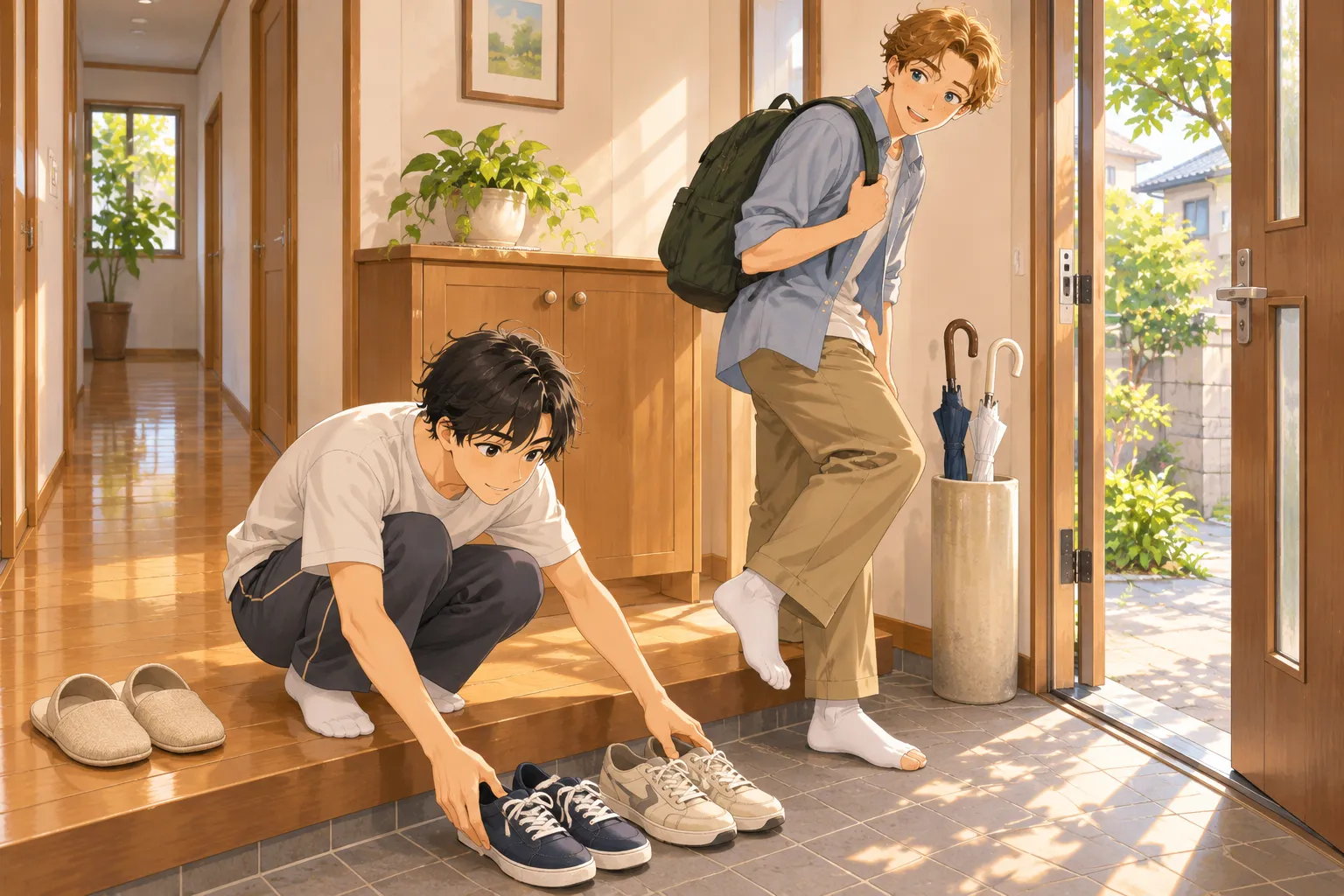
Illustration for the Japanese story Shoes Off at the Door

Lucas visits a Japanese friend's home for the first time and learns where outside ends and inside begins.

Tap any word for its meaning and sound.

ルカスは、はじめて友ともだちの拓也たくやの家いえに行いった。ドアを開あけると、せまい場ば所しょがあって、その先さきのゆかが少すこし高たかくなっていた。

Lucas went to his friend Takuya's house for the first time. When the door opened, there was a small space, and beyond it the floor was a little higher.

「ここでくつをぬいでね。」

"Take your shoes off here, okay?"

この場ば所しょを玄げん関かんという。日本にほんの家いえでは、玄げん関かんでくつをぬいでから中なかに入はいる。ルカスがくつをぬいで上あがると、拓也たくやはしゃがんで、二人ふたりのくつを反はん対たい向むきにそろえた。つま先さきが、ドアの方ほうを向むいている。

This space is called the genkan. In a Japanese home, you take off your shoes in the genkan before you go in. When Lucas had taken off his shoes and stepped up, Takuya crouched down and lined up both pairs facing the other way. Now the toes pointed toward the door.

「どうして反はん対たいにするの?」

"Why do you turn them around?"

「帰かえるとき、すぐはけるでしょ。」

"So you can slip right into them when you leave."

なぜ、日本にほんでは家いえに入はいるとき、くつをぬぐのだろう。理り由ゆうの一ひとつは、雨あめが多おおいことだと言いわれている。雨あめの日ひのくつはぬれていて、土つちでよごれている。もう一ひとつの理り由ゆうは、ゆかの使つかい方かたにある。日本にほんの家いえでは長ながい間あいだ、たたみのゆかにすわって食しょく事じをし、夜よるは同おなじゆかにふとんを敷しいてねる生せい活かつをしてきた。ゆかは、いすやベッドと同おなじように使つかう場ば所しょだから、いつもきれいにしておきたい。玄げん関かんの低ひくい場ば所しょまでが「外そと」で、高たかくなったゆかからが「中なか」だと考かんがえると、わかりやすい。

Why do people in Japan take off their shoes when they go into a house? One reason, it is said, is that it rains a lot. On a rainy day, shoes are wet and covered with dirt. The other reason is how the floor is used. For a long time, people in Japanese homes sat on the tatami floor to eat, and at night laid out their futons on that same floor to sleep. The floor is used the way a chair or a bed is, so people want to keep it clean. It is easy to understand if you think of the low part of the genkan as still "outside," and the raised floor as where "inside" begins.

家いえだけではない。多おおくの学がっ校こうでも、入いり口ぐちでくつをぬいで、学がっ校こうの中なかだけで使つかうべつのくつをはいて、教きょう室しつに行いく。たたみのへやがあるレストランや、古ふるいお寺てらでも、くつをぬぐことが多おおい。

It is not only homes. At many schools, too, students take off their shoes at the entrance and put on a different pair, worn only inside the school, before going to their classrooms. You often take your shoes off at restaurants with tatami rooms and at old temples, too.

拓也たくやの家いえでは、トイレにもべつのスリッパがおいてあった。ルカスはそれをはいたまま、へやにもどってしまった。

At Takuya's house, there was a separate pair of slippers just for the bathroom. Lucas walked back into the room still wearing them.

「あ、それ、トイレのだよ!」

"Hey, those are the bathroom ones!"

拓也たくやがわらって、ルカスもわらった。ルカスは、こんど来くるときはあなのあいていないくつしたをはいてこようと思おもった。

Takuya laughed, and so did Lucas. Next time he came, Lucas decided, he would wear socks without holes in them.

Check your understanding

3 questions about “Shoes Off at the Door”. Tap an answer to check it.

1. 拓也たくやは、ルカスのくつをどうしましたか。

2. 日本にほんの家いえでくつをぬぐ理り由ゆうの一ひとつは何なんですか。

3. ルカスは、何なにをまちがえましたか。

Words in this story

The first 40 of 102 different words in “Shoes Off at the Door”, in the order you meet them, in dictionary form, with reading and English. Particles are left out.

WordReadingMeaning
ルカスルカスLucas (male given name)
初はじめてはじめてfor the first time; only after ... is it ...; only when ... do you ... …
友とも達だちともだちfriend; companion
拓也たくやたくやTakuya (male given name)
家いえいえhouse; residence; dwelling; home; family
行いくいくto go; to move (towards); to head (towards); to leave (for); to move through
ドアドアdoor
開あけるあけるto open (a door, etc.); to unwrap (e.g. parcel, package); to unlock …
ととif; when; and; as well as; with
狭せまいせまいnarrow; confined; small; cramped; limited
場ば所しょばしょplace; location; spot; position; area
あるあるto be; to exist; to live; to have; to be located
そのそのthat; the; part (as in "part two"); um ...; er ...
先さきさきpoint; tip; end; nozzle; head (of a line)
床ゆかゆかfloor; stage (for the narrator and the shamisen player) …
少すこしすこしa little; a bit; a small amount; a few; some
高たかいたかいhigh; tall; expensive; high-priced; high (level)
なるなるto become; to get; to grow; to turn; to reach
ここここhere; this place; this point; here; now
靴くつくつshoe; shoes; boots; footwear; footgear
脱ぬぐぬぐto take off (clothes, shoes, etc.); to undress
このこのthis; last (couple of years, etc.); these; past; this
玄げん関かんげんかんentrance; front door; entryway; entranceway; entry hall
言いういうto say; to utter; to declare; to name; to call
日本にほんにほんJapan
中なかなかinside; interior; among; within; middle
入はいるはいるto enter; to come in; to go in; to get in; to arrive
上あがるあがるto rise; to go up; to come up; to ascend; to be raised
しゃがむしゃがむto squat; to crouch
二人ふたりふたりtwo persons; two people; pair; couple
反はん対たいはんたいopposition; resistance; antagonism; hostility; objection
向むきむきdirection; orientation; aspect; exposure; suited to
揃そろえるそろえるto collect; to gather; to get together; to complete (a collection); to arrange
つま先さきつまさきtoes; tips of the toes; toe of a shoe, sock, etc.
方ほうほうdirection; way; side; area (in a particular direction); side (of an argument, etc.)
向むくむくto turn toward; to look (up, down, etc.) …
どうしてどうしてhow; in what way; by what means; why; for what reason
するするto do; to carry out; to perform; to cause to become; to make (into)
帰かえるかえるto return; to come home; to go home; to go back; to leave (of a guest, customer, etc.)
時ときときtime; hour; moment; occasion; case

Readings and meanings are adapted from JMdict and KANJIDIC2, property of the Electronic Dictionary Research and Development Group, used under its licence (CC BY-SA 4.0). Still learning the kana? See the hiragana chart and the katakana chart.

Keep reading

This is one of the free stories in Japanese reading practice. In the Literate Japanese app every word you tap is saved for review, a natural Japanese voice reads each sentence, and the next story is matched to the kanji you know. The app is coming soon to iOS and Android.

Read your way to 300 kanji

Literate Japanese has 280+ graded stories from kana-only to estimated N2, with furigana you can turn off, every word one tap away, and flashcards built from what you read. The 60-chapter Reading Trail to your first 300 kanji is free. Coming soon to iOS and Android.

Email me when it launches

Start today in the browser: read a free Japanese story →