
HSK 2 Traditional Chinese Stories: 40 with Zhuyin & Pinyin
Every free story on this site at an estimated HSK 2 level, shown in Traditional characters (繁體字) and sorted easiest first. Switch the pronunciation guide between pinyin and zhuyin, tap any word for its meaning, and flip to Simplified any time. No sign-up.
- 40free stories
- 29%of characters look different from Simplified
- 371characters through HSK 2
- 117characters in a typical story
简 Prefer Simplified? Same stories in SimplifiedTest yourself: HSK 2 reading comprehension
What HSK 2 reading looks like in Traditional characters
At HSK 2, sentences start to carry time and sequence: 了 for finished actions, 過 for experiences, 在 for what is happening now, 比 comparisons, and 要, 想, 會, 能. Topics move into routines, transportation, weather and food, and stories turn into small plots that often run across several parts. In Traditional you will see more of the dense, high-frequency forms: 還, 對, 點, 書, 開, 車.
- 40 free stories at this level, 47–221 characters each (typically 117).
- 29% of the characters you read in them are written differently in Traditional than in Simplified; the rest are identical.
- 499 words / 371 characters in the 2026 HSK 3.0 lists through HSK 2, and 87% of the characters in these stories come from them.
- Pinyin or zhuyin on tap, Taiwan quotation marks (「」), and a Simplified switch if you need to compare.
Which TOCFL level is HSK 2?
| TOCFL | TOCFL levels | ≈ HSK | Read here |
|---|---|---|---|
| Band A | Level 1 入門級 (A1), Level 2 基礎級 (A2) | 1–2 | Beginner path, HSK 1, HSK 2 (this page) |
| Band B | Level 3 進階級 (B1), Level 4 高階級 (B2) | 3–4 | HSK 3, HSK 4 |
| Band C | Level 5 流利級 (C1), Level 6 精通級 (C2) | 5+ | HSK 5–6 (use the 繁 switch) |
The match is approximate: TOCFL and HSK use different word lists and test formats, and our story levels are estimates on the HSK 3.0 scale. See the TOCFL guide for the exam itself.
New to this level, or not sure you're at it? Try the beginner path (15 hand-picked stories in order), or take the 2-minute character test to see where you are.
Read 3 HSK 2 stories right now
Pronunciation off first, then turn it on for any sentence that stops you. Choose pinyin or zhuyin; tap any word for its meaning, and check yourself with Translation and the quiz under each story. Your settings carry over to every story.

1Ā Róng's Day Begins (Part 1)
Firefighter Ā Róng starts his day early at the fire station.
今天早上,阿榮五點就起床。This morning, Ā Róng woke up at five.他洗臉、刷牙,然後吃了一點麵包。He washed his face, brushed his teeth, and then ate some bread.
今天的天氣很熱,但是他還是要去工作。The weather was very hot today, but he still had to go to work.阿榮是一名消防員,他每天都很忙。Ā Róng is a firefighter, and he is busy every day.
他到消防隊時,同事們已經在整理工具。When he arrived at the fire station, his coworkers were already organizing the tools.他們一起檢查水管、頭盔和制服。They checked the hoses, helmets, and uniforms together.
阿榮喜歡這份工作,因為他可以幫助很多人。Ā Róng likes this job because he can help many people.他想:今天應該會是平靜的一天。He thought: today should be a peaceful day.
但他不知道,新的任務很快就要來了。But he didn't know a new mission would come soon.
Check your understanding
阿榮的工作是什麼?
阿榮為什麼喜歡這份工作?
阿榮到消防隊時,同事們在做什麼?

2The Frog in the Well
A frog at the bottom of a well is sure he knows how big the sky is. A little bird disagrees.
一隻青蛙住在井裡。A frog lived in a well.它每天從井裡看天。Every day it looked at the sky from inside the well.它說:「天只有一點點大。」It said, "The sky is only a tiny bit big."
一隻小鳥飛來,坐在井邊。A little bird flew over and sat at the edge of the well.小鳥說:「不對,天很大很大。」The bird said, "That's not right. The sky is very, very big."
青蛙不相信,笑了起來。The frog did not believe it and started to laugh.小鳥說:「你跳出來看看吧。」The bird said, "Jump out and take a look."
青蛙跳出井,看到了很大的天。The frog jumped out of the well and saw the huge sky.它說:「原來我知道的太少了!」It said, "So I knew far too little!"
這個成語是「井底之蛙」。This idiom is "a frog at the bottom of a well."意思是:一個人看到的很少,懂的也很少。It means: a person who has seen very little and understands very little.例句:不要做井底之蛙,多出去看看吧!Example: Don't be a frog in a well — go out and see more!
Check your understanding
What did the frog think about the sky at first?
Who told the frog the sky was big?
What did the frog learn after jumping out?

3Xiao Bai's Night (Part 1)
Xiao Bai's Story: a stray cat finds a cardboard box, and a kind stranger.
小白是一隻流浪貓,他走在安靜的街上。Xiao Bai was a stray cat, walking down a quiet street.他正在找吃的,因為今天還沒吃東西。He was looking for food, because he hadn't eaten anything all day.
路邊有一個小餐廳,裡面的人正在說話。There was a small restaurant by the road, with people talking inside.小白走過去,希望能找到一點飯。Xiao Bai walked over, hoping to find a little food.
餐廳外有一個紙盒,小白跳進去休息。Outside the restaurant was a cardboard box, and Xiao Bai jumped in to rest.天氣有點冷,他把身體縮得小小的。The weather was a little cold, so he curled up into a small ball.
不多久,一個女孩走出來。Before long, a girl came out.她看見小白,輕輕說:「你餓了嗎?」She saw Xiao Bai and said softly, "Are you hungry?"女孩放了一點飯在紙盒前。The girl put a little food in front of the box.小白慢慢走過去,心裡變得暖暖的。Xiao Bai slowly walked over, and his heart grew warm.
Check your understanding
小白為什麼在街上找吃的?
小白在餐廳外做了什麼?
小白為什麼心裡暖暖的?
How to practice reading at HSK 2 in Traditional
- Follow a series rather than jumping around: the names, places and characters repeat, so each part is easier than the last.
- Try a story with the pronunciation guide off first, and turn it on only for the sentences that stop you.
- Check yourself with the translation toggle after each paragraph, not before.
- Notice character families: once you know 門, the 門 in 問, 間 and 開 makes new characters easier to remember.
Grammar you will practice here
Patterns from our Chinese grammar guide that have a story on this page built around them:
- Verb + 過Past experiences with 过practiced in Grandpa's Map (Part 1)
- A + 沒有 + B (+ 這麼/那麼) + Adj.Not as … as: 没有practiced in We Stop Comparing (Part 1)
- Subj. + 給 + Person + VerbDoing something for someone: 给practiced in Checking into a Hotel (Part 1)
- A + 離 + B + 近 / 遠Distance with 离practiced in A Student's Morning (Part 1)
- 從 A 到 BFrom … to …: 从…到…practiced in A Busy School Day (Part 1)
- Verb + 得 + (很) Adj.How well? Verb + 得practiced in Playing Ball Together
- A 還是 B? / A 或者 BOr: 还是 vs 或者practiced in At the Pharmacy (Part 1)
- Verb + (了) + DurationHow long: duration after the verbpracticed in The Phone on the Bench (Part 1)
All 40 HSK 2 stories in Traditional Chinese
Start with these 5
The five gentlest HSK 2 stories on this page that stand on their own, shortest and easiest first, each with a picture and a quick quiz.
- 1
 Playing Ball TogetherThe puppy is playing ball, and the kitten wants in. Who's faster?
- 2
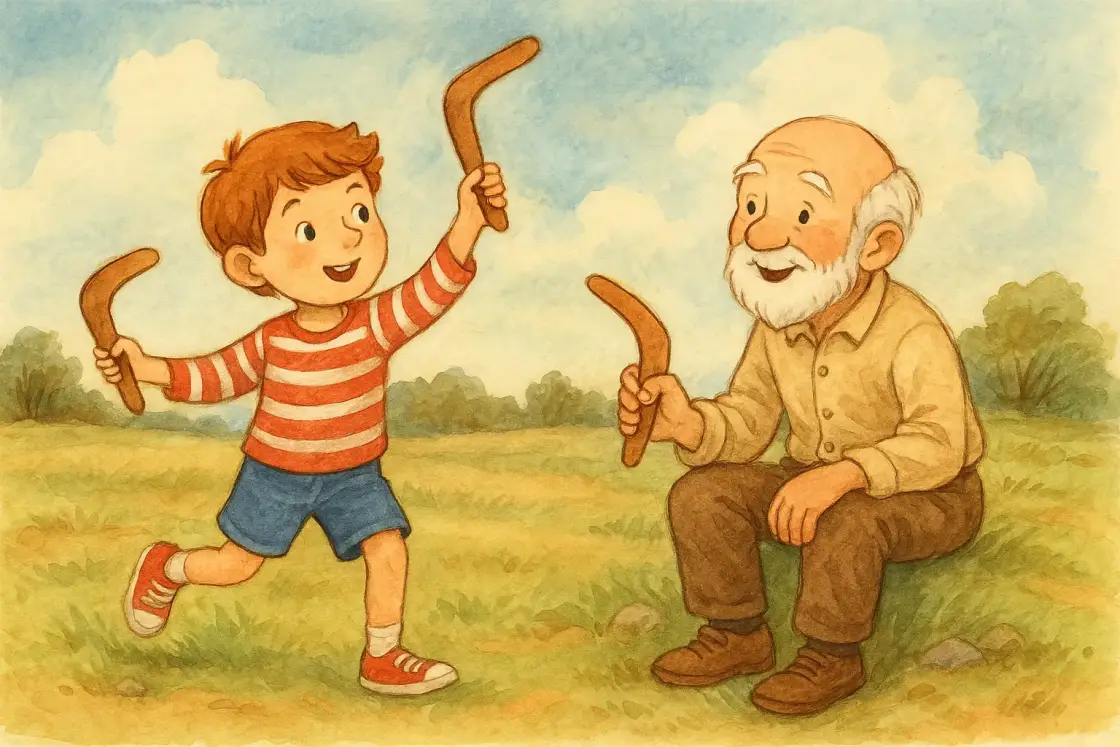 Benny and the BoomerangGrandpa says a boomerang always comes back. Benny's just keeps landing in the grass.
- 3
 Grandpa's Map (Part 1)Grandpa's Travels: a map covered in little red stars.
- 4
 We Stop Comparing (Part 1)A little sister and her big brother compare everything, and discover they each win at something.
- 5
 A Student's Morning (Part 1)A Day in the Life of a Student: Xiao Lin and his three alarms.
Grouped by theme and sorted from easiest to hardest within each group (by length and word difficulty). Parts of a series stay together and in order. Reading times are rough estimates at a comfortable HSK 2 pace. Stories open in Traditional characters.
Grammar in Context 13 stories
- Grandpa's Map (Part 1)小雨的爺爺家裡有一張大地圖。地圖上有…
- The Old Photos (Part 2)爺爺拿出一本老相冊。“這張照片是我在…
- We Stop Comparing (Part 1)哥哥比我大兩歲。我沒有他這麼高。我跑…
- Morning Runs (Part 2)我和哥哥不比了,現在他教我跑步。每天…
 A Busy School Day (Part 1)從星期一到星期五,我都要上學。從我家…
 Learning to Swim (Part 2)我會畫畫,可是我不會游泳。星期六,哥…
 The Phone on the Bench (Part 1)星期天,小丁在公園跑步。他在長椅上看…
- Looking for Clues (Part 2)小丁看了看手機的屏幕。桌面的照片是在…
 Mom Knows Best (Part 1)明天我要一個人坐火車去看朋友,媽媽比…
 Back to Dad's City (Part 1)放假的時候,我跟爸爸回了他小時候住的…
 Who Ate the Cake? (Part 1)昨天晚上,我在冰箱裡放了一塊蛋糕,準…
 Little Habits (Part 1)我們家每個人都有一點自己的小習慣。爺…
 A Saturday of Choices (Part 1)星期六早上,我問弟弟今天想做什麼。他…
Survival Chinese 7 stories
 Ordering at a Restaurant (Part 1)中午,李明和朋友走進一家小餐廳。服務…
- That's Not What We Ordered (Part 2)一個星期後,李明跟朋友又來到那家餐廳…
 Checking into a Hotel (Part 1)晚上八點,王小姐到了酒店。她對前臺說…
- A Problem at Midnight (Part 2)半夜,王小姐醒了,房間裡太冷了。空調…
 At the Pharmacy (Part 1)李明有點感冒,頭疼,還咳嗽。他走進一…
- Seeing a Doctor (Part 2)三天過去了,李明的感冒還沒有好。晚上…
 A Gift for Mom (Part 2)小美想給媽媽買一個生日禮物。週末,她…
AP Chinese Themes 11 stories
 Fish and Meat (Part 2)一個女孩從餐廳裡走出來。她是小白的好…
- New Friends (Part 1)今天天氣很好。小貓和小狗出去玩。他們…
 The Astronauts Come Home三個宇航員回家了。他們在太空住了八個…
- A New Home for the Pandas北京動物園有十隻大熊貓。七月,熊貓們…
 The Kitten and Puppy Arrive (Part 2)約翰和小婷坐在餐廳外面。這時,一隻小…
- A Walk on a New Street (Part 1)星期六,天氣很好。約翰:我們帶米飯去…
 Getting Ready (Part 2)爸爸媽媽明天就到了。今天,約翰和小婷…
 Lele Learns the House (Part 2)樂樂想幫忙做事。它先學掃地。它掃得又…
- Good News for Elephants在非洲,有一個很大很大的公園。這個公…
- The Frog in the Well一隻青蛙住在井裡。它每天從井裡看天…
- The Robot Games這個月,北京有一個很特別的運動會。運…
Daily Life & Work 4 stories
- A Student's Morning (Part 1)小林是一名高中生。他早上六點半起床…
 An Engineer's Morning (Part 1)林工程師早上七點半起床。他在台北工作…
 A New Morning (Part 1)早上七點,奕翔起了個早。他洗臉、刷牙…
- Ā Róng's Day Begins (Part 1)今天早上,阿榮五點就起床。他洗臉、刷…
More Stories 5 stories

Key HSK 2 words in these stories
The HSK 2 words (HSK 3.0 list) that turn up most often across these stories, in Traditional characters with pinyin and zhuyin. Learn these first and you will meet each of them again and again. Browse the full HSK 2 word list for everything else.
- 走zǒuㄗㄡˇto walkin 12 of 40 stories
- 就jiùㄐㄧㄡˋthenin 12 of 40 stories
- 一起yī qǐㄧˋ ㄑㄧˇtogetherin 7 of 40 stories
- 拿náㄋㄚˊto takein 7 of 40 stories
- 得de˙ㄉㄜused after a verb to indicate degreein 7 of 40 stories
- 從简 从cóngㄘㄨㄥˊfromin 6 of 40 stories
- 已經简 已经yǐ jīngㄧˇ ㄐㄧㄥalreadyin 6 of 40 stories
- 比bǐㄅㄧˇcompared toin 6 of 40 stories
- 跟gēnㄍㄣwithin 6 of 40 stories
- 快kuàiㄎㄨㄞˋfastin 6 of 40 stories
- 白色bái sèㄅㄞˊ ㄙㄜˋwhitein 5 of 40 stories
- 著简 着zhe˙ㄓㄜ(aspect particle) indicating ongoing actionin 5 of 40 stories
- 還是简 还是hái shiㄏㄞˊ ㄕˋorin 5 of 40 stories
- 出來简 出来chū láiㄔㄨ ㄌㄞˊto come outin 5 of 40 stories
- 開始简 开始kāi shǐㄎㄞ ㄕˇto beginin 5 of 40 stories
- 跑pǎoㄆㄠˇto runin 5 of 40 stories
- 別简 别biéㄅㄧㄝˊdon'tin 5 of 40 stories
- 外面wài miànㄨㄞˋ ㄇㄧㄢˋoutsidein 4 of 40 stories
- 過去简 过去guò qùㄍㄨㄛˋ ㄑㄩˋthe pastin 4 of 40 stories
- 一會兒简 一会儿yī huìrㄧˊ ㄏㄨㄟㄦˋa whilein 4 of 40 stories
- 門口简 门口mén kǒuㄇㄣˊ ㄎㄡˇdoorwayin 4 of 40 stories
- 進去简 进去jìn qùㄐㄧㄣˋ ㄑㄩˋto go inin 4 of 40 stories
- 爺爺简 爷爷yé yeㄧㄝˊ ˙ㄧㄝpaternal grandfatherin 4 of 40 stories
- 教jiāoㄐㄧㄠto teachin 4 of 40 stories
More HSK 2 stories in Traditional, with Taiwan Mandarin audio
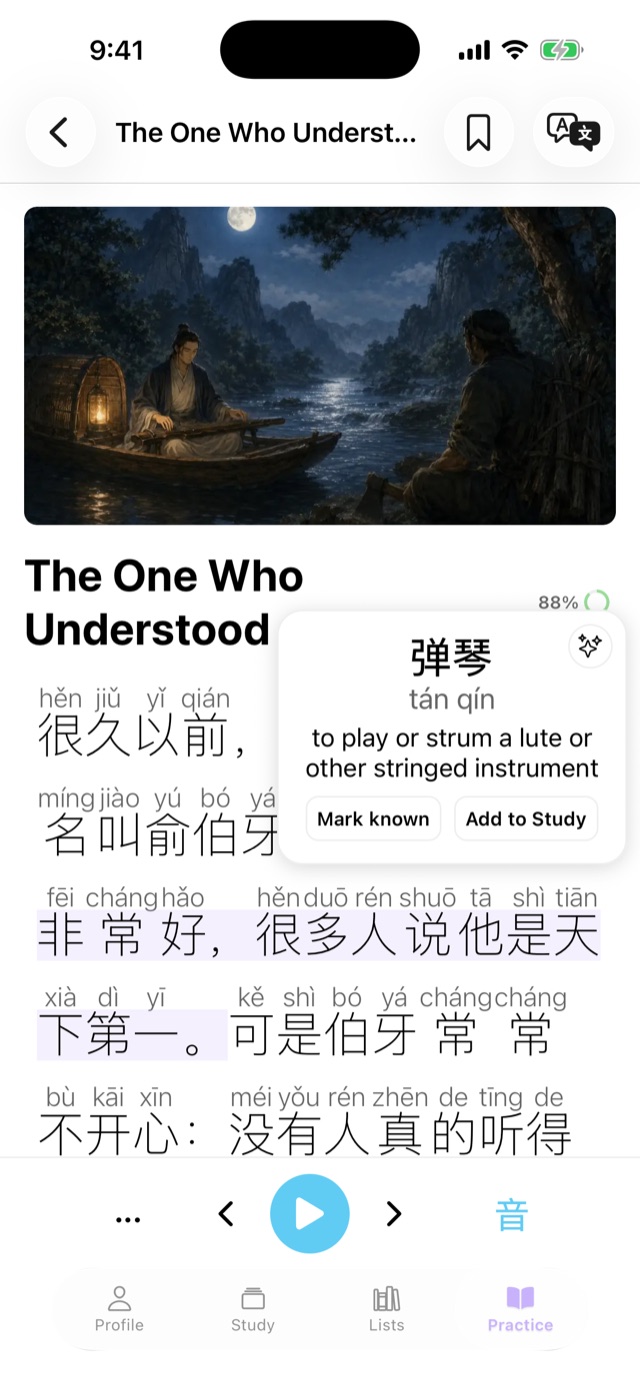
The Literate Chinese app has 209 more stories at this estimated level beyond the 40 here, out of 1,000+ graded stories, all available in Traditional characters. It tracks the words you actually know and shows how familiar each story is, so you can pick ones that are just hard enough.
Every story can be narrated in Taiwan Mandarin, shown with zhuyin inline or in the vertical layout Taiwanese books use, and any word you tap can become a flashcard.


Frequently asked questions
Is traditional Chinese harder to read?
A little harder to write, not much harder to read. Traditional characters have more strokes, and in the 40 stories on this page 29% of the characters you read look different from their Simplified forms (學/学, 車/车, 嗎/吗). But reading is recognition, not writing: the extra components often make a character more distinctive (愛 keeps its 心, heart), and after you have seen a form a few hundred times in sentences, stroke count stops mattering. The stories are the same graded stories as the Simplified pages, so apart from the script the difficulty is the same.
Which level should I start at for TOCFL?
Roughly: TOCFL Band A (Levels 1–2) is close to HSK 1–2, Band B (Levels 3–4) to HSK 3–4, and Band C to HSK 5 and above. This page fits TOCFL Band A. If you are new, start with the beginner path; if a story here feels easy, move up a level. The match is approximate because the two exams use different word lists. See our TOCFL guide.
Can I read these stories with zhuyin?
Yes. Turn on Pronunciation and choose Zhuyin (ㄅㄆㄇ) above any story on this page. The zhuyin comes from the same dictionary as the app, so it uses Taiwan readings where that dictionary lists them, and it prints 一 and 不 with their changed tones, as Taiwanese books do. The individual story pages show pinyin; the app has zhuyin, including the vertical layout, on every story. New to zhuyin? Start with our zhuyin guide.
How many characters do I need for HSK 2 reading?
The 2026 HSK 3.0 syllabus has 499 words through HSK 2, written with 371 different characters, and they are the same words in Traditional. You can start well before you know them all: 87% of the characters in these 40 stories are HSK 1–2 characters, and any word is one tap away from its meaning.
Will the stories stay in Traditional when I open them?
Yes. Opening a story from this page keeps Traditional characters on, and every story page has the same 简/繁 switch, which remembers your choice.
Also useful: Not sure of your level? Take the 2-minute character test · HSK 2 word list · TOCFL guide · Learn zhuyin · Zhuyin reading practice · HSK 2 stories in Simplified · All traditional reading practice